
Paver Patios and Paver Repair
Fackrell Masonry and Construction builds and repairs paver patios, walkways and driveways across southern Idaho, for homes and commercial properties: new work laid on a heavy compacted base, sunken pavers reset, joints cleaned and re-sanded, borders added, and faded pavers sealed.
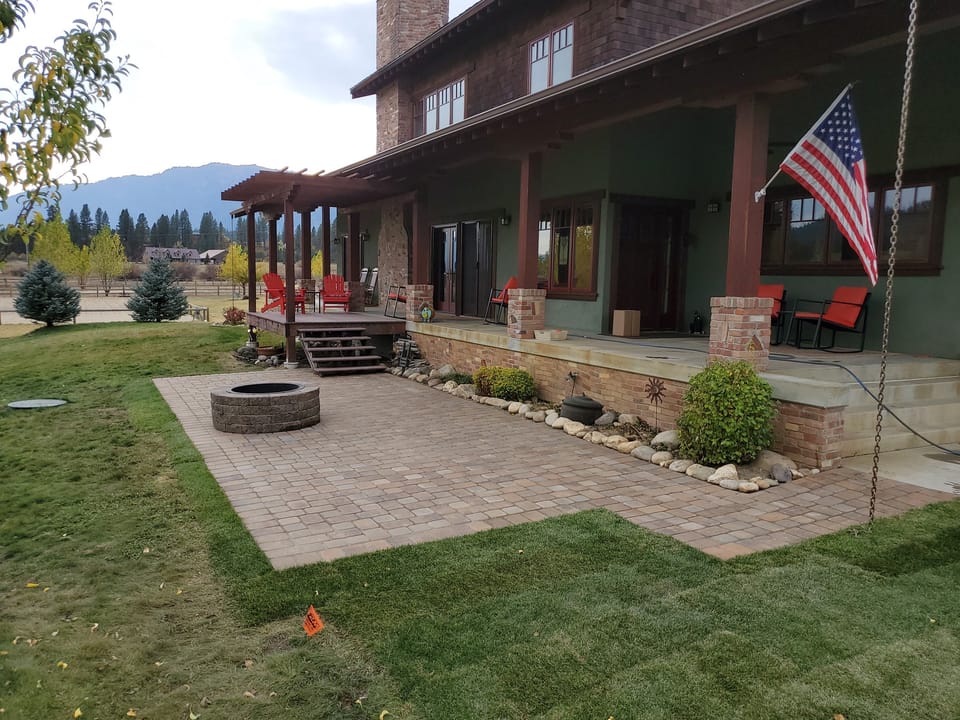
The most important part of a paver job is the part you never see again once it's finished. The patios I tear out are commonly sitting on about two inches of base, and that's exactly why they've gone wavy underfoot. Where a patio sits somewhere a vehicle could reach, a back door or a side yard, I'd rather build the base to driveway standard from the start than come back and explain why a moving truck left ruts in it.
Pavers do need some maintenance over time. They settle into low pockets you can feel through your shoes, vegetation gets into the joints, and unsealed pavers fade in the sun. None of that means tearing the patio out. The settled areas get lifted and reset on a gravel and sand-cement base, the joints get cleaned and re-sanded, and a wet look sealer brings the color back.
A patio is rarely just a flat surface, either. Full-width steps that get rid of an awkward drop to the driveway, planter columns with the water and drain lines run inside them before any facing goes on, seat walls, borders, and small pads that end up doing a job nobody planned for. This work is as common on commercial ground as residential. Entries, courtyards, restaurant patios and common areas all take the same beating, just with more feet on them.
What this covers
- New paver patios, walkways, entries and driveways. The old surface out, the grade set, and a compacted base built before a single paver is laid
- Base depth matched to what the surface actually has to carry. The Interlocking Concrete Pavement Institute, the trade body that writes the installation standards for segmental pavement, puts the minimum compacted base at 4 inches under a patio or walkway and 6 under a residential driveway over well-drained soil. In a climate that freezes and thaws all winter, closer to 6 and 9 is the honest answer, and more where the soil is soft, silty or wet
- Base built to driveway standard anywhere a vehicle could plausibly end up, which is cheaper to decide now than to find out later
- Sunken pavers lifted and reset onto a gravel and sand-cement base, which holds them a lot longer than gravel alone
- Pavers cleaned, vegetation cleared out of the joints, and the joints re-sanded with a sand-cement filler
- Masonry borders around the perimeter, because without something holding the edge the outside pavers walk
- Wet look sealer to bring the color back out of pavers that have faded, or a finish you can't see at all, whichever you're after
- Steps, seat walls, planter boxes and faced columns built into the patio, with water and drain lines roughed in ahead of the masonry
- Commercial and multi-family hardscape. Entries, courtyards, restaurant patios and common areas, where the traffic count is what drives the design
- Accessible walkways laid to the Americans with Disabilities Act (ADA) Standards for Accessible Design, where running slope, cross slope, width and a surface that stays smooth and stable are what the route has to hold. Pavers do it well on a proper base, and a walkway that settles into low spots has stopped meeting anything, so an accessible route is the last place to thin a base out
- Sod and edges put back tight against the border when the work is finished, so your yard doesn't look like a job site for the rest of the season
How to tell you need this
- Low spots you can feel underfoot. Pavers settle when the base under them is too thin. On a repair the gravel-only base comes out and a gravel and sand-cement base goes in, which holds them much longer.
- Edge pavers drifting out of line. Without something holding the perimeter, the outside pavers move. A masonry border around the edge keeps them where they were laid.
- Color gone flat and gray. Unsealed pavers fade in sunlight. Cleaning and a wet look sealer brings the color back out.
- Grass and weeds coming up through the joints. The joint filler is gone. Cleaning the joints out and re-sanding them with a sand-cement filler closes them back up.
- Ruts or dips where a vehicle has been parking. That's a base built to patio standard carrying driveway loads, and it'll keep moving until the base is corrected.
- An awkward high step down off the patio to the driveway. That's a build problem instead of a maintenance one, and a proper full-width step solves it.
Questions people ask
Do you build paver patios in Boise and Meridian?
Yes. The service area is all of Southern Idaho, between the Oregon and Wyoming borders, reaching as far north as McCall, Stanley, New Meadows and Salmon. I work from Nampa in the Treasure Valley and Blackfoot in eastern Idaho. New patios and repairs to existing ones both, residential and commercial. Start with a quote by clicking here.
Why do pavers sink?
The base under them, nearly always. A base that's too thin won't hold pavers in position, and about 2 inches is a depth I find regularly on patios I'm called out to fix. On a repair the gravel-only base comes out and a gravel and sand-cement base goes in, which holds the pavers a lot longer than gravel alone.
The other common culprit is drainage. Water running under a patio takes the fines out of the base and the surface follows it down, so a patio that only sinks in one corner is usually telling you where the water goes.
My pavers heaved up over the winter and settled back in the spring. Why?
Frost, and water that had nowhere to go.
Water in the ground under a patio expands when it freezes and lifts whatever's sitting on it. In this climate that happens over and over through a winter instead of once. Come spring the ground relaxes and the pavers drop back down, but never quite where they started, and every winter moves them a little further.
Two things prevent it and both are under the surface. A base deep enough to sit below the worst of the movement, and drainage so the water isn't sitting there to freeze in the first place. That's why base depth isn't fussiness. A patio on two inches of base in Idaho is a patio that moves every single winter.
If yours heaves in one area and not the others, go look at what's above it. A downspout, a low spot in the yard, a sprinkler head. The water is arriving from somewhere, and finding it is usually the cheaper half of the fix.
Weeds keep coming up between my pavers and the sand washes out every year.
Those are one problem, not two. The joints are empty.
Joint filler is what makes a paver surface behave like one surface. Once it washes out, the pavers can shift individually, water runs straight down between them and takes more filler with it, and anything blowing past has somewhere to germinate. The weeds aren't coming up through the patio. They're growing in the gap you can now see.
Plain sand is what usually washes out, especially anywhere water runs across the surface or a pressure washer has been used on it. Re-sanding with a sand and cement filler holds up a great deal better, because it sets up in the joint instead of sitting there loose.
The other half is the edge. Without a border holding the perimeter, the outside pavers walk outward, everything behind them loosens a little and the joints open up across the whole field. Weeds worst at the edges is that.
While the joints are open is also the moment to lift anything that's settled, so it all happens once.
A white haze has come up on my new pavers. Did something go wrong?
Almost certainly not. That's efflorescence, and on new work it's normal.
Pavers have cement in them, and cement produces free salts as it cures. Moisture carries those salts to the surface and evaporates, and the salt stays behind as a white bloom. It has nothing to do with how the patio was laid.
Most of it weathers off on its own over the first year, and that's the cheapest way to deal with it. If you'd rather not wait, start with a brush and a small amount of water, small because water is what brings the salt to the surface in the first place. Past that there are cleaners made for efflorescence. Be aware that it doesn't always come off completely, particularly once it's been sitting a while.
The important part is not sealing over it. Seal it in and the haze is under the finish permanently.
So clean it or wait it out, let the pavers dry properly, then seal. On an older patio a bloom that keeps coming back is a different conversation, because there the salt is arriving with water from somewhere and it's worth finding out where.
Can faded pavers be brought back, or do they have to be replaced?
They can usually be brought back. Pavers fade in sunlight when they were never sealed. Cleaning them, taking the vegetation out of the joints, re-sanding with a sand-cement filler and putting a wet look sealer on brings the color back out. A masonry border around the perimeter often goes in at the same time, to stop the edge pavers moving. Sealer is maintenance instead of a permanent fix, and four or five years is what to expect from it in this climate. On a driveway or anywhere else tires and boots are working on it, plan on less.
Can you fix part of a patio without tearing the whole thing out?
Usually, yes. The settled areas get lifted and reset on a proper base while the rest of the patio stays where it is. Then the whole surface is cleaned, re-sanded and sealed, so the repaired sections don't stand out.
One thing I'll be straight about. Fixing the settled section doesn't fix what caused it. If the base under the whole patio was built too thin, the rest is sitting on that same base and can settle later. A partial repair often holds for years and is usually the sensible call on cost, but it's worth going in knowing which of the two you're buying.
Full tear-out is for a patio failing everywhere, or one that's the wrong size or the wrong height to begin with.
How deep a base do you put under a patio?
Depends what it has to carry and what it's sitting on. The Interlocking Concrete Pavement Institute puts the minimum compacted base at 4 inches under a patio or walkway and 6 under a residential driveway, over well-drained soil. In a climate that freezes and thaws all winter, figure closer to 6 and 9, and more if the soil is soft, silty or wet.
Two inches is a depth I find regularly, and it's where sunken pavers come from.
It's also where two prices for the same patio quietly part company. The base is gravel, the trucking to bring it in, and the hours spent packing it down, and every bit of it is buried by the end of the first day. Put in half as much and the patio looks perfect the day it's finished, still looks fine the following summer, and starts to move the winter after that.
So ask each of them how deep the base is going in and how they're packing it down. Those two answers explain the difference in price better than either man will.
How long should a paver patio last?
The pavers themselves will outlast most of the house. They're dense units, they don't rot, and a cracked one gets pulled and swapped in about twenty minutes without disturbing its neighbors. That's the real advantage of laying a surface in pieces, and it's why people choose it.
What has a service life is everything else. Joint filler needs topping up over the years. Sealer, if you use it, is on a cycle. And the base is what decides whether the patio is flat in twenty years or wavy in five.
That's why the money on day one goes below the surface. Nobody has ever regretted a base heavier than it needed to be, and the patios I get called out to tear up almost never failed because of the pavers.
Do pavers have to be sealed?
No. Plenty of patios go their whole life unsealed and hold up fine. It's a choice about how you want it to look and how much you want to fight stains.
Sealed, the color stays where it started instead of going flat and gray in the sun, and oil, leaf tannin and barbecue accidents sit on the surface long enough to be cleaned up instead of soaking straight in. Unsealed, the patio slowly fades, and there's a fair argument that a weathered patio looks better for it. Some people genuinely prefer it.
What sealer isn't is structural. It doesn't hold pavers in place and it won't fix a base problem. Sealing a patio that's already moving is money spent on a nice finish over a problem that's still there.
If you do seal, treat it as maintenance on a cycle. Four or five years is what to expect in this climate, and less on anything you drive or walk on, because tires and boots take it off mechanically.
Can a vehicle drive or park on a paver patio?
Only if the base was built for it. Where a patio sits somewhere a vehicle might reach, like beside a back door or along a side yard, the base wants driveway standard instead of patio standard. If there's any chance of a vehicle ending up on it, say so before the base goes in. Building it heavy the first time is far easier than rebuilding it afterward.
Can you build a walkway that meets accessibility requirements?
Yes. Accessible walkways in pavers are regular work, on commercial ground and at houses where somebody needs to get in and out without a fight.
The requirements come out of the Americans with Disabilities Act (ADA) Standards for Accessible Design, and the ones driving the build are running slope, cross slope, width, and how smooth and stable the surface has to stay. That last one is where pavers earn their place and also where they get people into trouble. A paver walkway laid flat on a proper base with tight joints handles it easily. A paver walkway on a thin base doesn't stay flat, and once it has settled into low spots and open joints it has stopped meeting anything, whatever it met the day it was finished.
So on accessible work the base is not the place to save money, and neither is the edge restraint. Those two are what keep the surface where it was set.
Tell me at the start if a route has to be compliant. It changes the grading before it changes anything else.
Stone patios and pavers projects
Real jobs, my own photos, and what the problem actually turned out to be.
Paver patios and a fishing deck
A worn-out brick patio torn out and rebuilt on a driveway-grade base, plus a second small paver patio down by the pond.
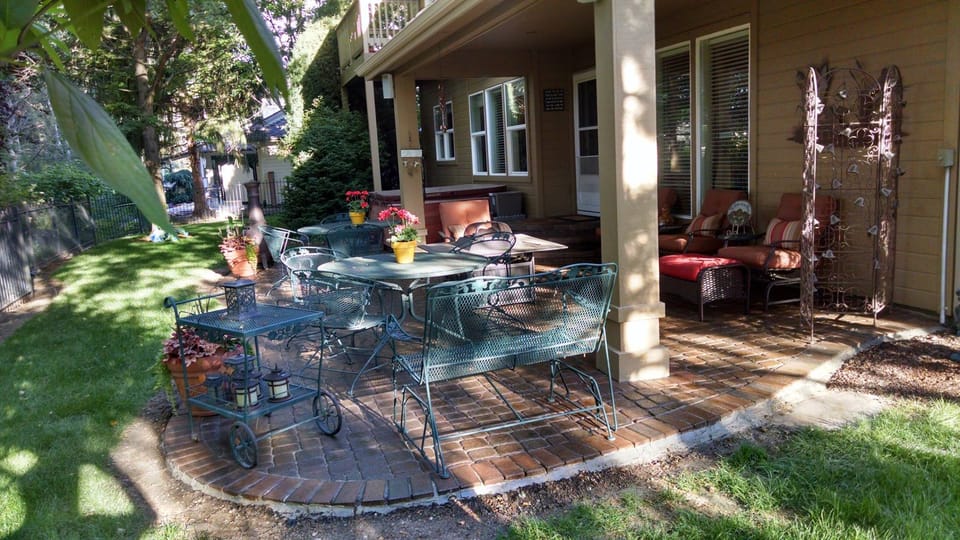
Paver repair and restoration
Sunken pavers reset on a gravel and sand-cement base, joints re-sanded, a masonry border added and the faded patio sealed.
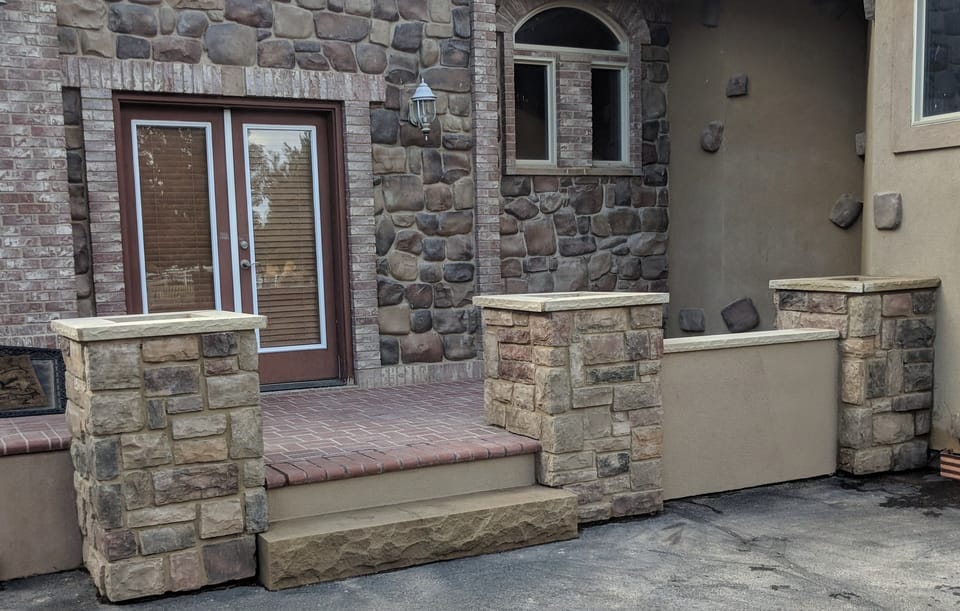
Patio upgrade
A failing brick patio rebuilt with stone-veneered planter columns and a full-width stone step, ending the awkward high step down to the driveway.