
Historic masonry restoration
Fackrell Masonry and Construction restores historic brick and stone buildings across Southern Idaho, repointing, replacing failed brick, and rebuilding chimneys to match the original work. Past projects include the 1865 Miners Exchange in Idaho City and Hangar 208 at Mountain Home Air Force Base.
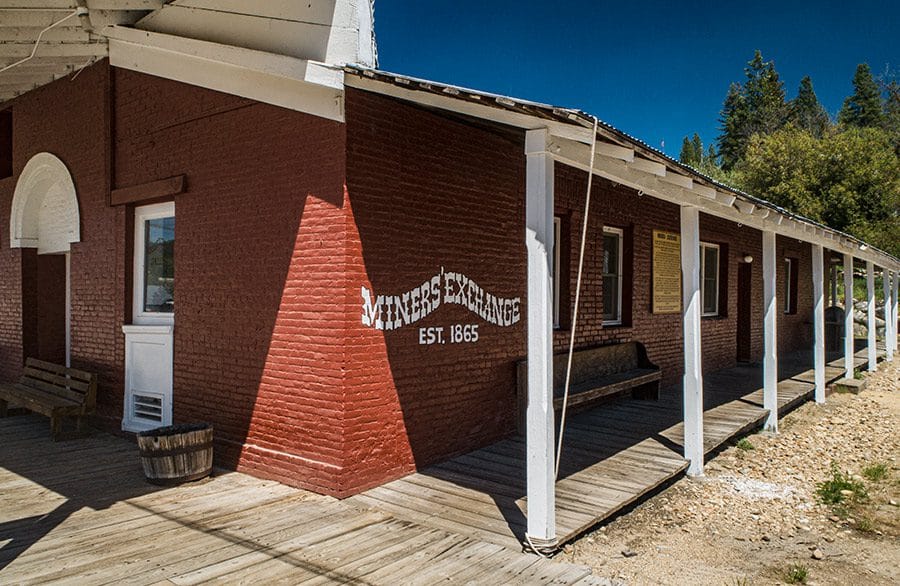
Old buildings aren't complicated. They're just old. The Miners Exchange has been sitting on the boardwalk in Idaho City since 1865, and by the time we got to it the brickwork was genuinely at the end of its rope. A stair-step crack ran clear across the wall under the porch, the brick had come apart around the old wood lintels, and the bottom courses had eroded back until there was more air than brick. What it took to buy that building another century was new brick and correct mortar. Nothing exotic. Just a whole lot of patience and the right mix.
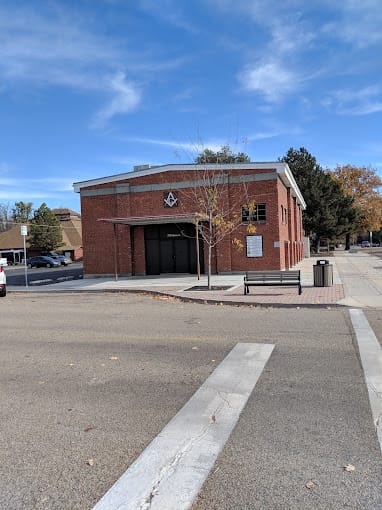
That's the shape of most restoration work. The Meridian Masonic Temple took the better part of a week of combing the building for damaged brick and open joints before anything got laid. On an old wall, what you can see from the sidewalk is a fraction of what's there. On Hangar 208 at Mountain Home Air Force Base the requirement was short to write down and long to do. Repair the damaged brick and repoint the mortar to match the original, on a building the Air Force intends to keep.
There's older work behind this too, from years before any of it reached a camera. Masonry construction of the Blackfoot McDonald's. Multiple United States Forest Service comfort stations. The stone restoration of the Oregon Short Line Railroad Depot, now the Idaho Potato Museum. The photographs didn't survive the era. The buildings did.
What this covers
- Failed brick cut out and replacements patched in, chosen to follow the size, shape and bond pattern of the original work
- Full repointing instead of spot repairs, so the joints read the same across an entire elevation instead of in visible patches
- Mortar matched as closely as the materials allow. My dad and I built our own sample set over years of trial and error and it gets us to about 75%. You can't get an exact match on a weathered wall, and anybody who promises one hasn't done much of this
- A mix no harder than the masonry it's going into. This is the single most important rule in restoration, and the National Park Service builds Preservation Brief 2 around it. Old brick is soft, and a modern high-strength mortar won't yield, so the brick faces spall off instead. A great deal of the damage on historic buildings was created by a well-meaning repair
- Laboratory analysis of the original mortar on the jobs that genuinely warrant it, so the new mix is built on what the old one actually was instead of on a guess from the ground
- The top of a chimney or stack rebuilt, then the shaft below it repointed
- Stair-step cracking, eroded bottom courses, and brick that's come apart around old wood lintels repaired
- Boom lift and scaffold work for walls, parapets and stacks a ladder won't reach
- Stone restoration as well as brick, including the stone on the Oregon Short Line Railroad Depot, now the Idaho Potato Museum
- The whole building walked before anything is quoted, to find every bad brick and open joint instead of the ones showing from the sidewalk
How to tell you need this
- A crack that steps down through the mortar joints in a staircase pattern
- The bottom courses of brick at the sidewalk crumbled back until there's more air than brick
- Mortar joints you can rake out with a key, or joints washed out deep enough for moss to take hold
- Brick faces flaking or popping off. That's spalling, and on an old building it usually means a hard modern mortar went into a soft old wall at some point
- Brick coming apart above a door or window. It might be the old lintel behind it and it might not. Either way it's worth having looked at
- Loose brick at the top of a chimney or parapet, or pieces that have already come off
Questions people ask
Do you restore historic buildings in Idaho City, Boise and the rest of Idaho?
Yes. Fackrell Masonry and Construction has restored the Miners Exchange in Idaho City, the Meridian Masonic Temple, and Hangar 208 at Mountain Home Air Force Base. The service area is all of Southern Idaho, between the Oregon and Wyoming borders, as far north as McCall, Stanley, New Meadows and Salmon. Start with a quote by clicking here.
My house is old but it isn't a landmark. Is this the right page for me?
Probably, yes. Age is what matters here, not a plaque.
The reason this is its own page isn't paperwork. It's that old masonry behaves differently. Old brick was fired at lower temperatures and is comparatively soft, the lime-rich mortars built for it were softer still on purpose, and both of those change what a repair has to be. An 1890s wall and a 1990s wall want different mortar, and treating the old one like the new one is how the faces end up coming off the brick.
So if your house is genuinely old, the approach on this page is the one your wall wants, whether or not anybody official has ever taken an interest in it.
Where a listing does matter is the paperwork around the work, and any constraints that come with grant money or a preservation easement. That's a real difference, and it's about process rather than about the masonry.
The faces are flaking off the brick on my old house. Can that be repaired?
The flaked brick, no. Once a face has popped off there's no putting it back, and nothing gets sprayed or troweled on to bring it back either. What can be done is replacing the worst of them and stopping whatever is doing it.
The word for it is spalling, and on an old building it usually traces to one of two things. The common one is a hard modern mortar that went into a soft old wall at some point. Something in a wall has to give with the seasons, and if the mortar won't, the brick does. The other is water, getting in and freezing inside brick that's already porous.
So the repair starts as a diagnosis. Replace spalled brick and leave hard mortar in the joints around it and the new brick starts spalling too, and now you've bought the job twice.
That's why the mortar question comes before the brick question on every old building I look at.
Why does old brick need different mortar than new brick?
Because a wall has to have somewhere to move, and whatever's softest is where the movement goes.
Old brick was fired at lower temperatures and is comparatively soft. The lime-rich mortars built for it were softer still, on purpose, so the mortar took the seasonal movement and gave itself up slowly while the brick stayed intact. Repointing a joint is cheap. Replacing a wall of ruined brick isn't.
Put a modern high-strength mix into that wall and it flips around. The mortar is now harder than the brick, so the brick becomes the part that gives, and the faces start popping off within a few winters.
What makes it the most expensive mistake in old masonry is that almost nobody makes it on purpose. The strong modern mortar is the one sitting on the pallet at the supply yard, easier to buy and easier to work with, so somebody who's never worked on an old building reaches for it believing he's doing you a favor. What it costs you is the face of the brick. Once those flake and pop off there's no putting them back, and the only repair left is replacing the brick itself.
What does restoring an old brick building cost?
More per square foot than the same work on a modern building, and often less than people fear once they see what's actually needed.
What drives it is mostly the finding. The Meridian Masonic Temple took the better part of a week just combing the building for damaged brick and open joints before anything got laid, and on an old wall what shows from the sidewalk is a fraction of what's there. That walk has to happen before anybody can put a real number on it. Anybody quoting an old building from the street is quoting a guess.
After that it's access, since parapets and stacks want a lift or scaffold. The proportion of brick being replaced against joints being repointed, because brick replacement is much slower work. And whether the specification calls for laboratory analysis of the mortar, which belongs on some buildings and is a waste of money on others.
What I'd push back on is doing a third of the building now and coming back in five years. The setup gets paid for twice and the color match gets harder, not easier.
Who's qualified to work on a historic building?
There's no registration with historic mason written on it, which is exactly the problem. Start with the legal floor. Ask for the state registration number and look it up at the Idaho Division of Occupational and Professional Licenses, and check that masonry is the trade named on it, not a handyman code. Anybody who clears that bar can still bid your building, though, and an old building will punish the wrong choice for a century.
So ask for evidence instead. What old buildings has he worked on, and can you go look at one. What mortar is he proposing and why, because the right answer involves a soft mix and the wrong answer involves whatever was on the pallet at the supply yard. How deep is he cutting the joints. Whether he's read the National Park Service Preservation Brief 2, or can at least describe what's in it without being prompted.
The single question that sorts most of it out is this. Ask what happens if the new mortar ends up harder than the brick. Anybody who has actually worked on old buildings will have an immediate and slightly emphatic answer.
And if the building is listed, or there's preservation funding involved, there'll be requirements attached about the work and about documentation. Find out what those are before you take bids, because they change the job.
Can you match the mortar on an old brick building?
Not exactly, and anybody who promises otherwise hasn't done much of this. The wall you're matching has been weathering for well over a century in some cases, so it isn't the color it was mixed as, and some of what went into it isn't made or mined anymore.
On a significant building a sample can go to a laboratory to establish what the original actually was. Even then the result isn't a twin. It's a mix built on the real thing instead of on somebody's eye. That gets to about 75%, and 75% is what makes a repair read as part of the wall instead of a patch.
Will the new mortar and brick look obvious when you're done?
Fresh mortar looks loud against 150-year-old brick, and there's a stage in the middle of a job like this where the whole wall looks worse than it did on day one. That's normal and it's worth being warned about. It settles down as it cures and weathers, and on a painted building like the Miners Exchange the paint goes back over the top of it anyway.
Does the whole wall have to be repointed, or only the bad spots?
Depends how much of the wall has gone. On the Miners Exchange the whole wall came in, because the joints in between the obvious failures weren't holding much either.
On smaller work, customers often ask for a whole element to be repointed anyway so the color comes out uniform instead of patchy, and that's usually money well spent. You'll get a straight answer on which one your wall actually needs, including when the answer is less work instead of more.
Do you send the mortar off to a laboratory?
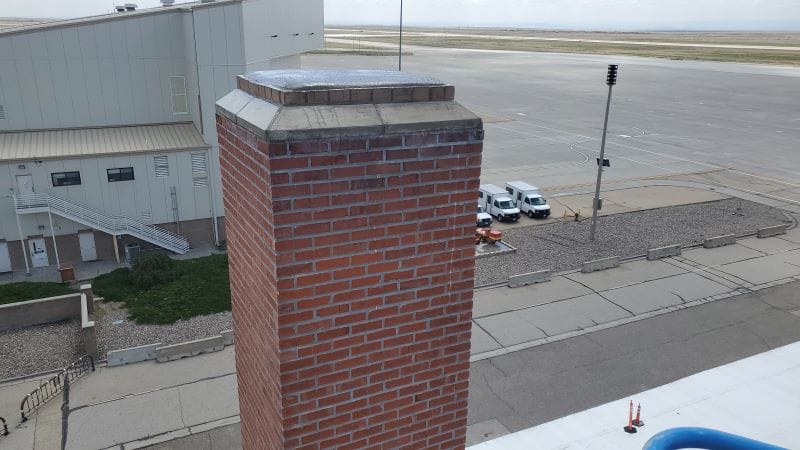
Only on the jobs that warrant it. Analysis is a real cost and it belongs on a large historic project where the specification calls for it, which is why the Hangar 208 stack got one. On a house the same money does more good in the work itself, and you'll hear that instead of getting an invoice for it.
It's also worth knowing what analysis actually buys you. It tells you the makeup of the old mortar instead of leaving somebody to eyeball it from the ground. It doesn't produce a twin, because there's no such thing. The sand came out of an Idaho riverbed a century ago, and nobody can go back and get more of it.
Have you done restoration work on government or landmark buildings?
Yes. The chimney stack on Hangar 208 at Mountain Home Air Force Base was a historical restoration, where the requirement was to repair the damaged brick and repoint the mortar to match the original. The family has also built multiple United States Forest Service comfort stations and did the stone restoration of the Oregon Short Line Railroad Depot, now the Idaho Potato Museum.
Historical restoration projects
Real jobs, my own photos, and what the problem actually turned out to be.
Miners Exchange, Idaho City
Brick repair and full repointing on the 1865 Miners Exchange in Idaho City, replacing failed brick and mortar so the walls hold another century.
Mountain Home Air Force Base, Hangar 208
Chimney restoration on Hangar 208 at Mountain Home Air Force Base: damaged brick replaced and the stack repointed with mortar mixed to a laboratory analysis of the original.
Meridian Masonic Temple
General repointing and brick repair on the Meridian Masonic Temple, with damaged brick and worn mortar found and replaced across the whole building.
Often needed alongside
Tuckpointing and repointing
Cutting out failed mortar and replacing it, matched as closely as the materials allow.
Tuckpointing and repointing →Chimney repair
Rebuilds, crowns, flue liner work and repointing.
Chimney repair →Commercial masonry
Storefronts, offices and public buildings, new and repaired.
Commercial masonry →