
Brick, Stone and Block Work
Fackrell Masonry and Construction builds new brick, stone and block work across southern Idaho. Veneer on houses and commercial buildings, cut sandstone and block walls, pillars and columns, outdoor kitchens, and interior brick and stone.
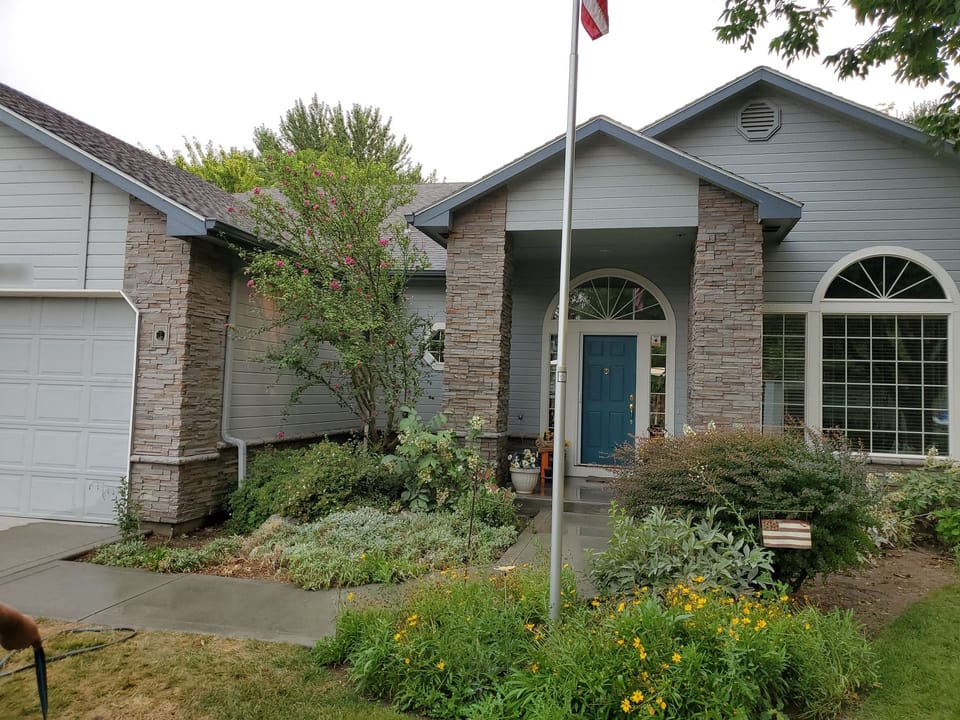
This is the building side of the trade instead of the repair side. Same hands and the same mortar, but the job is putting up something that wasn't there before, or taking off a finish, usually stucco or siding, that never suited the building and is often failing besides.
Veneer is a lot of it. Replacing stucco or siding with stone or brick is regular work for me, on houses and commercial buildings both. Entry columns, garage piers, building corners, a wainscot under the windows. Veneer goes where the eye lands. It changes the front of a building without touching the paint, the roof or the floor plan, and on a house whose front door had disappeared into forty feet of flat siding, that's usually the whole idea. Once the stone is on, people can find the front door.
Walls and outdoor living take up the rest. Cut sandstone and block fence walls, with capped pillars at the drive and the gate. Outdoor kitchens and bars built in around countertops and appliances. Planter boxes with the water and drain lines run inside them before any facing goes on. And indoors, brick or stone on a plain wall, which changes a room in a way paint can't, because you're adding texture and shadow instead of another color.
What this covers
- Stone and brick veneer on houses, commercial buildings and outbuildings, including entry columns, garage piers, building corners, window wainscot, and stucco or siding replaced with masonry
- The wall behind the veneer, which is what decides whether the stone is still on the building in ten years. The weather barrier, the lath, the scratch coat and the mortar setting bed. Clearance at the bottom comes into it too. The International Residential Code, section R703.12, wants four inches above earth on a stud wall, and the installation standard drops that to two inches on concrete or block, so the bottom course is never standing in the dirt wicking water up behind itself
- Freestanding fence, garden and courtyard walls in cut sandstone, brick or block, on a poured footing with rebar through the cores, because a wall with nothing under it goes wherever the frost decides to send it
- Pillars and columns built to carry what they're actually carrying, then faced and capped in matching brick or stone so the whole run reads as one piece
- Outdoor kitchens and bars, fitted in around countertops, grills and appliances you've already picked out, with the utilities roughed in ahead of the facing
- Seat walls, planter boxes and planter columns, with water and drain lines run inside them before the masonry goes on
- Interior brick and stone. Accent walls, kitchen walls above a wainscot, fireplace surrounds and stair walls, including the returns at doors and corners that make an interior wall look built instead of stuck on
- Engineered and manufactured stone as well as natural stone. Natural stone varies piece to piece and some of it barely takes mortar at all, while manufactured units come in consistent sizes with a back made to bond. Which one suits a wall is worth settling before anything is ordered
- Mortar color and joint profile picked to suit the building, because the mortar is the grid your eye follows across a wall, and the wrong color shows from the street more than the stone does
Questions people ask
Do you do brick and stone work in Boise and Nampa?
Yes. The service area is all of Southern Idaho, between the Oregon and Wyoming borders, reaching as far north as McCall, Stanley, New Meadows and Salmon. I work from Nampa in the Treasure Valley and Blackfoot in eastern Idaho. Fackrell Masonry and Construction has been an Idaho masonry family since 1971. Start with a quote by clicking here.
People call it stone siding or faux stone. Is that the same thing as veneer?
Same thing, different names. Stone siding, faux stone, stone facing, stone veneer. All of it means a stone face on a wall that something else is holding up.
The distinction that actually matters is what the stone is. Natural stone veneer is real rock, cut thin. Manufactured stone is cast, so it arrives in consistent sizes and colors with a back made to bond to mortar. Both are veneer. Both go on over a weather barrier, lath, a scratch coat and a mortar setting bed, and both fail the same way when one of those gets left out.
Manufactured has a reputation problem it mostly doesn't deserve. The failed manufactured stone I get called out to look at didn't fail because it was manufactured. It failed because of what went on behind it.
So don't spend much time on which word the bid used. Spend it on what's going behind the stone.
What does stone veneer cost per square foot?
Square footage is the easiest thing to measure on a wall and one of the worst things to price from.
Here's what actually moves it. What's on the wall now, because taking an old finish off is a job before the stone job starts, and what turns up underneath decides the rest. How high the work is, since anything off scaffold or a lift carries the cost of getting up there. The stone itself, which ranges enormously. And the corners, openings and returns, because a wall with six windows and four outside corners in it is far more cutting and fitting than a flat run of the same area.
That last one is why two jobs with identical square footage come back at different prices and neither man is wrong.
What a square foot rate definitely doesn't tell you is what's going behind the stone, and that's the part deciding whether it's still on the building in ten years. Get your number from somebody who has looked at the actual wall.
Stone is coming off my building and it's only a few years old. Why?
I see this constantly, and nearly always on stacked stone and manufactured stone panels. Water gets in behind the units, freezes, and pushes them off the wall.
You can check it yourself. Walk the wall and tap. A bonded stone sounds solid. A loose one sounds hollow, and some will move under your hand.
One or two loose stones on a large wall is normal and unavoidable. What I turn up is a different animal. I'm out looking at jobs most weekends and run across one of these almost every time. Ten or twenty loose on a single wall, two or three already on the ground. Past twenty, nobody has to guess. That wall wasn't installed by a professional.
Nearly always it comes back to bonding, or to what never went on behind the stone. Again, low bidder work.
There are cracks running through my block wall. Is that serious?
Depends which way they run and whether the wall is still flat.
A crack that steps up through the mortar joints in a staircase pattern is usually the wall answering to something underneath it. A footing that's settled, frost, a tree root. A straight crack running through the block units themselves took more force to make, and that one gets my attention faster.
What actually decides it is plane. Stand at one end and sight down the face of the wall. Still flat, and you're most likely looking at repointing and swapping out the cracked units. Bowing, leaning, or a crack noticeably wider at one end than the other, and that section is moving. Moving walls get rebuilt instead of patched, because a patch in a moving wall is just a fresh crack waiting its turn.
Take a photo now with something in it for scale and take the same photo in three months. A crack that hasn't changed is a very different problem from one that has, and that difference is worth more than any single opinion about the crack itself.
My retaining wall is leaning out at the top. Does the whole thing have to come down?
Usually, and I'd rather say so now than halfway through the job.
A retaining wall leans for one reason. The soil behind it is pushing harder than the wall can push back, and that's nearly always water. Drainage rock behind the wall, a drain line at the bottom and somewhere for the water to get out are what keep the pressure down. Where those got left out, the soil behind the wall stays saturated, and saturated soil is heavy.
Resetting the top courses without dealing with what's behind them buys a season, maybe two. Then it goes right back, because nothing about the cause changed. The honest repair is taking it apart, putting the drainage in and rebuilding, and anything going back up is subject to that same four foot cap unless it's engineered.
Bulging in the middle is the same conversation. And a wall that's gone past leaning and started to tip is a safety problem, so keep people and vehicles off the low side of it until somebody has looked.
How tall of a retaining wall can you build?
Four feet in block. Past four feet a retaining wall needs an engineered design, and depending on what your local code requires that can mean a stamped drawing before anybody pulls a permit. I build block and segmental retaining walls up to that four foot cap.
Height isn't really what holds a retaining wall up anyway. A retaining wall spends its whole life resisting the weight of wet soil pushing sideways, and what beats it is nearly always the base, the drainage behind it or the backfill. Get those wrong at three feet and it'll lean on you just the same.
So if what you need is taller than four feet, say so at the start. Getting a design in hand early is a good deal cheaper than finding out after the block has been ordered. And on a tall slope it's worth asking whether two shorter walls would suit the ground better than one tall one, which is a question to put on the table before anybody assumes.
Do you build garden and fence walls?
Yes, in cut sandstone, brick or block. They go up on a poured footing with rebar through the cores, unit after unit, set by hand. Property line walls, garden walls, courtyard walls, and the capped pillars that land at a drive or a gate, faced to match so the whole run reads as one piece.
The footing is the part nobody ever sees and the part that decides whether the wall is still straight in twenty years. It's also, not coincidentally, where fence wall bids differ from one another.
Can stone or brick replace stucco on the front of a building?
Yes, and it's regular work on houses and commercial buildings both. The stucco comes off first, down to the substrate. Laying new masonry over an old finish leaves the new work depending on a surface that was never meant to carry it, whatever anybody tells you. What's behind the stucco decides how a particular building gets approached, so that gets looked at on site before anybody quotes it.
Can you do brick inside a building, not just outside?
Yes, and interior brick and stone is some of the most satisfying work there is. Accent walls, kitchen walls above a wainscot, fireplace surrounds, stair walls, and commercial interiors that want some texture on them.
Inside has its own considerations. The joints get tooled or washed depending on the look you're after. The returns at doors, corners and stair openings have to be worked out ahead of time so the brick doesn't stop dead at an edge and announce itself as an add-on. And the floor and framing have to carry the weight, which is worth checking before anybody orders brick. None of it is difficult. All of it is particular.
Do you work with engineered stone?
Yes, regularly. Outdoor kitchens and bars, full-height chimney chases, wainscot on commercial fronts, interior walls. Engineered stone is a manufactured product, so the sizes and the color range stay consistent, which makes it a good fit anywhere a particular look has to repeat across a large face. With mortar in the joints it does well outdoors. Dry-stacked outdoors it runs into the same trouble natural stacked stone does.
How can I tell if my brick is veneer or solid?
Go to a window or a door and find somewhere you can see the thickness of the wall.
On a solid brick wall you'll see more than one layer of brick, and you'll usually see headers. Those are bricks turned end-on at intervals through the field of the wall, tying the layers together, so you get a short brick face where all the others are long. A regular pattern of those and you've very likely got solid masonry.
Veneer has no reason to do that, so every brick reads the same length, and behind that single layer is framing.
It matters because the two aren't the same patient. Solid brick is carrying the building, so damage in it is a structural conversation. Veneer is carrying nothing but itself, and what's behind it is where its troubles come from. Same brick, same mortar, different diagnosis.
What's supposed to go behind stone before it's set?
Four things, and once the wall is up you can't check a single one of them.
A weather barrier over the sheathing, so anything that gets past the stone has somewhere to go. Lath fastened back to the framing, which is what the mortar grips. A scratch coat over the lath, keyed while it's still green so the next coat has something to hold. And a mortar setting bed, roughly half an inch, with the back of each stone buttered before it's set. That's what the standard practice for adhered masonry veneer calls for, ASTM C1780.
That last one is the bonding step, and it's the one that gets shortchanged most. Miss any of the four and you've got a wall that looks finished and isn't.
Ask about all four before you hire anybody. If he can't answer, beats around the bush, or gets it wrong, I wouldn't hire him if he were free. Then watch the installation, not just the bid. Sometimes the man you're talking to knows exactly how it's done and the crew he sends out doesn't.
And before you hand anybody the job, ask for the state registration number and look it up at the Idaho Division of Occupational and Professional Licenses. Masonry should be named on it. A handyman code is not a masonry qualification, and no registration at all on a job of any size is against the law here. It's the floor, not the finish line, so check it and then still ask what he's built.
Why is one stone bid so much lower than another?
Because the cheapest way to install stone is to leave part of the job out, and almost nobody can tell by looking.
Two things get skipped. The joint, which isn't decoration. It locks the stone to the wall behind it and keeps water out. Fill it partway and the wall still looks finished the day the crew drives away. And bonding, which surprises people. Mortar doesn't glue stone to a wall, it keys into it, and that only happens if the back of the stone and the surface behind it are both prepared. Skip that and the stone is sitting on the wall instead of stuck to it. From the sidewalk you can't tell. Old man winter can. He'll happily pull those stones off all winter long.
The trade calls the result low bidder work. Come in twenty percent under the professionals, do half the work, and you make more than any of them while the customer thinks he got a deal. He did, right up until the first hard winter.
So ask what goes in the joints, ask what goes behind the stone, and ask what the wall is standing on. Anybody who'd rather not discuss the parts you can't see has just told you not to hire him.
There's a cheap check worth doing before you pick any of them. Get the state registration number off each bidder and look them up at the Idaho Division of Occupational and Professional Licenses. The trade on the registration should say masonry. A handyman code is not a masonry qualification, it's a form somebody filled in, and a bidder with no registration at all isn't allowed to take the work in the first place. It won't tell you who's good. It will thin the list out fast.
How close to the ground can stone veneer go?
Not all the way down, and how close depends on what the stone is stuck to.
On a stud wall the International Residential Code, section R703.12, wants four inches above earth and two above paving. On concrete or block the installation standard drops that to two inches from grade. Only full-thickness stone bearing on the foundation goes all the way to grade, because there the footing is carrying it instead of the wall.
The reason is the same every time. Stone run down into the dirt wicks water up behind itself, and water behind stone is what freezes and pushes it off the wall.
Is stacked stone a good idea in Idaho?
Indoors, yes, and it looks terrific. A stacked stone fireplace never sees weather, and I'll build you one any day of the week.
Outdoors is a different question and my answer is no. Stacked stone has no mortar in the joints, so there's nothing keeping water out of them. Wind-driven rain fills them from every direction, it freezes, and the stone starts coming off. Some masons will tell you it's fine as long as it's installed right. In this climate I've yet to see an installation good enough to beat physics.
If you want the look outdoors anyway, that's a fair choice and I'll build it. You'd be trading service life for appearance, and that's a trade worth making on purpose instead of by accident.
Are some stones a poor choice for outdoor masonry?
Yes, and two of them turn up around here a lot. Both come down to the same thing. Mortar doesn't glue stone to a wall, it keys into it, and it wants a rough, absorbent face to grip.
Natural river rock gives you neither. Water tumbled it smooth over a few thousand years and it barely absorbs, so the bond is weak before you start. Then the shape works against you, and that part rarely gets explained. A river rock face is curved, so the only place a joint could properly capture the stone is at the widest point of that curve. That point is a line with no width to it, and every stone bulges differently, so in practice a joint finishes either short of it or past it.
Short of it, the mortar is pressing against the underside of a curve and holding nothing. Past it, the mortar has to thin down over the curve to a knife edge, and a thin edge is the first thing to crack in a hard freeze. Either way water gets in behind the stone and the failure spreads from there.
Oakley stone is a bonding problem too. It's a dense Idaho quartzite, and dense means it barely absorbs, so there's little for the mortar to pull into. What I find on those walls isn't chips off the face. It's whole stones on the ground.
Manufactured river rock is a different product and not the same conversation. It's a thin veneer with a back made to bond, and it does the job.
New brick, stone and block projects
Real jobs, my own photos, and what the problem actually turned out to be.
Stone veneer replacing stucco
The stucco on a house front taken off and replaced with stone veneer on the entry columns, garage piers, and window wainscot.
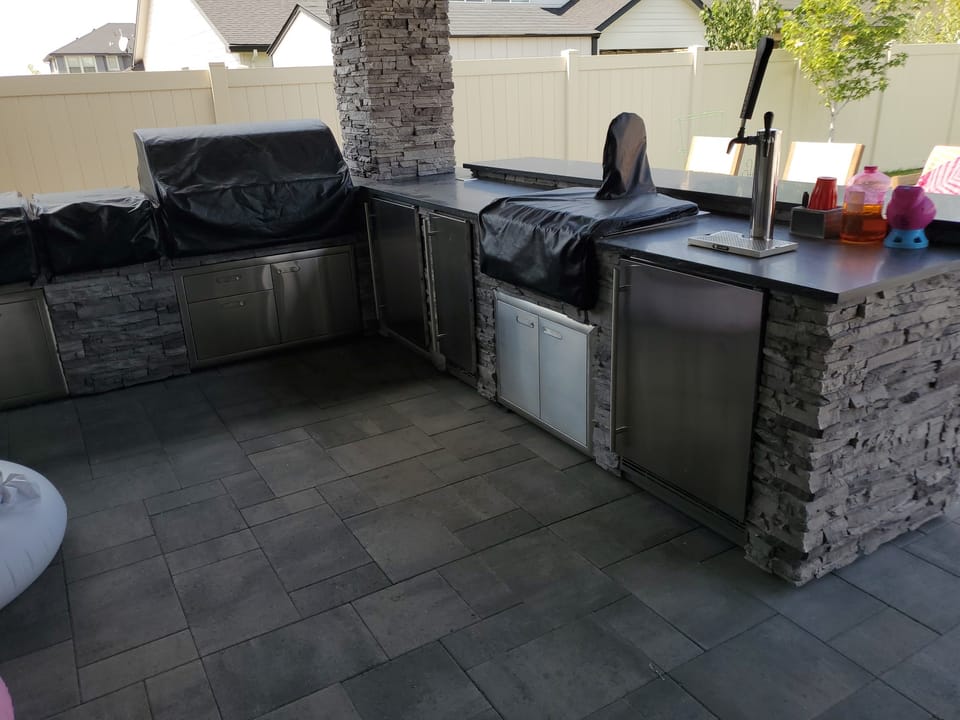
Outdoor kitchen
An outdoor kitchen and bar on a covered paver patio, faced in engineered stacked stone with a matching stone column.
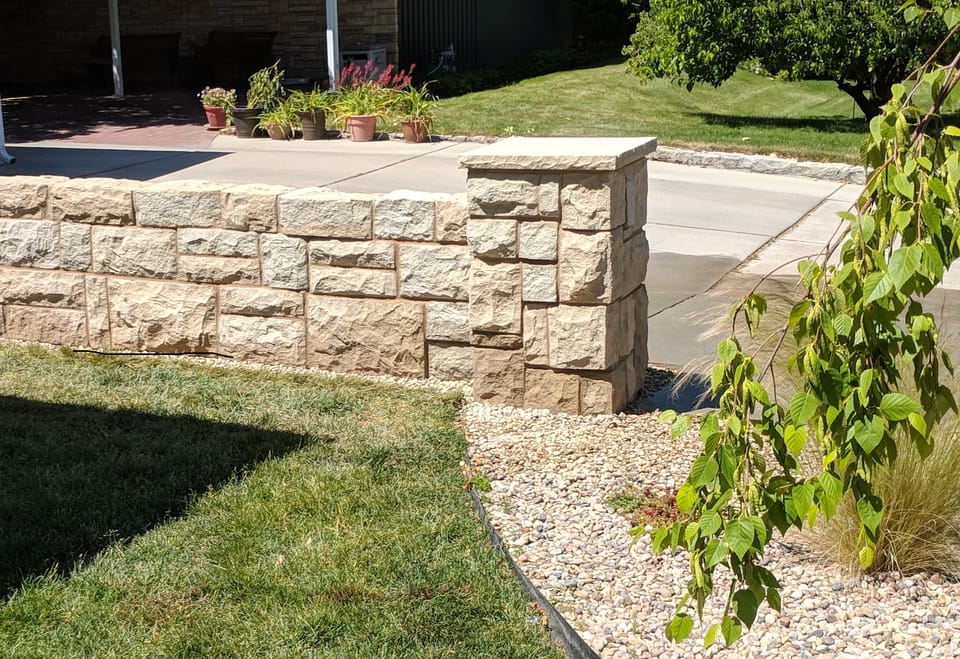
Sandstone fence
A cut sandstone fence wall and matching capped pillar built along a driveway, on a footing dug entirely by hand.
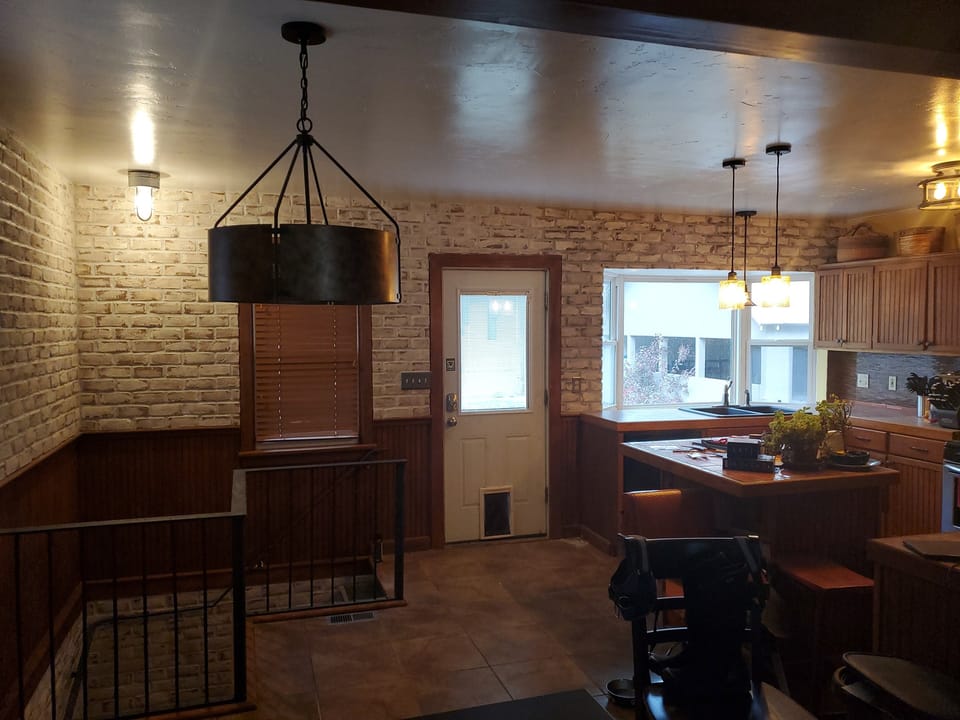
Dressing up a plain wall with brick
A plain painted kitchen and stairwell wall faced in pale brick above the wood wainscot, carried down the stair.
Often needed alongside
Fireplaces
Indoor and outdoor fireplaces, hearths, surrounds and new chimney chases.
Fireplaces →Stone patios and pavers
Patios, walkways and driveways laid on a base that holds.
Stone patios and pavers →Masonry sealing and commercial cleaning
Sealing for brick, stone and pavers anywhere. Cleaning on commercial size work.
Masonry sealing and commercial cleaning →