
Commercial masonry
Fackrell Masonry and Construction does commercial masonry across Southern Idaho: stone veneer, brick and block on new buildings, plus repointing, chimney and storefront repair on existing ones. Past work includes the Owyhee County Courthouse in Murphy and a new Industrial Metals building.
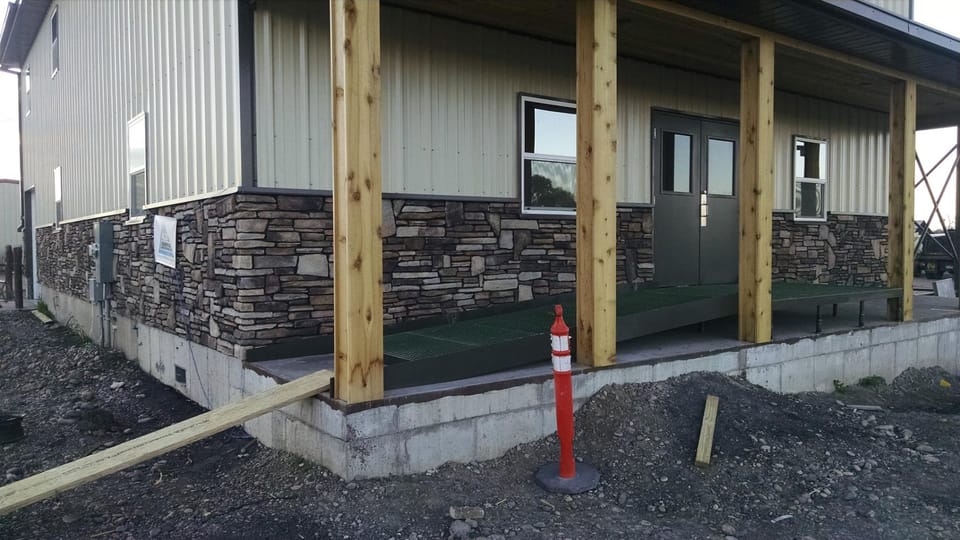
New commercial work tends to start the same way. Bare sheathing, a stem wall, and my dad out front sizing up the situation and sharing his years of wisdom whether anybody asked or not. He was 81 when we ran the veneer on the Industrial Metals building and he's 92 now, and he still shows up when he can. He's amazing. Veneer on a commercial front usually runs from the stem wall up to a belt line under the windows. On a job that spans the season you take freeze precautions in the first week and fight the heat by the middle. All in a day's work for a mason.
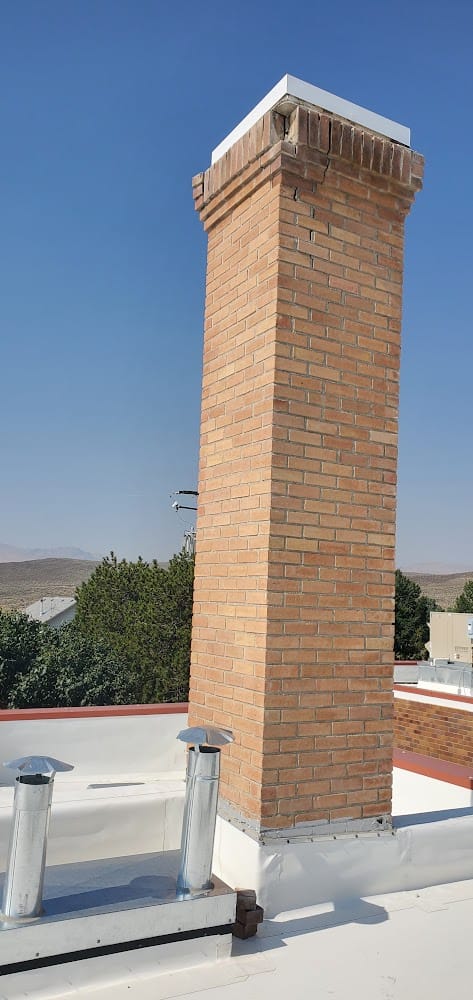
The other half of commercial masonry is buildings that are already up. The pattern repeats itself from one property to the next. Mortar eroding around the envelope, parapets and chimneys losing brick, water finding its way into the wall itself. On the Owyhee County Courthouse chimney the erosion was worst in the corbelled section under the crown, with several bricks loose on top and a few already gone. Loose brick standing over a public entrance is always the part that gets dealt with first, whatever else the building needs.
Fackrell Masonry and Construction does general construction as well as masonry, and that matters more on commercial work than anywhere else. When a vehicle comes through a storefront, the damage rarely stops at the stone. Framing, sheathing, interior finishes and the masonry all get handled by one crew on one schedule, and that's usually the difference between a store reopening this month and next.
What this covers
- Stone, brick and block veneer on new commercial buildings, worked from the stem wall up, and scheduled around the other trades so the masonry isn't the thing holding your job up
- Structural and screen block walls, and block cut out and replaced where a wall has been damaged
- Whole buildings repointed where mortar is separating, cracking or eroding around the envelope. On older buildings the joint gets cut back two to two and a half times its width, which is what the National Park Service calls for in Preservation Brief 2 and what a proper bond needs
- Chimney, parapet and stack repair on commercial and public buildings, worked from a boom lift where a ladder won't reach
- Storefront repair after vehicle damage, including the framing, sheathing and interior behind the masonry
- A written assessment listing every issue found on the building, the likely cause of each, and the repair options, in a form you can budget against or take out to bid
- The cause dealt with along with the damage. A leaking rain gutter above eroded stone, a downspout discharging at a wall base, or the missing curb or bollard where vehicles keep arriving
- Cold and hot weather work, with freeze precautions early and late in the season, because mortar that freezes before it cures never reaches the strength it was supposed to
- Public and government work under Idaho Contractors License RCE-41697 and Idaho Department of Public Works registration 017315, Occupational Safety and Health Administration (OSHA) 30 certified, veteran owned
How to tell you need this
- Mortar separating, cracking or eroding around the building, even though it still looks fine from the parking lot
- Brick or stone on the ground under a wall, or a gap opening up at a corner
- Water staining or eroded stone under a rain gutter or downspout
- Efflorescence, the white powdery bloom on a wall face, which means water is moving through the masonry and carrying salts out with it
- A vehicle has hit the building and the hole goes past the masonry into the wall behind it
- Loose brick at the top of a chimney or parapet standing over a public entrance
Questions people ask
Do you do commercial masonry in Boise and the Treasure Valley?
Yes. Fackrell Masonry and Construction works out of Nampa in the Treasure Valley and Blackfoot in eastern Idaho. The service area is all of Southern Idaho, between the Oregon and Wyoming borders, as far north as McCall, Stanley, New Meadows and Salmon. Start with a quote by clicking here.
Are you licensed for commercial and public work in Idaho?
Yes. Fackrell Masonry and Construction holds Idaho Contractors License RCE-41697 and Idaho Department of Public Works registration 017315, and is Occupational Safety and Health Administration (OSHA) 30 Construction Certified. The company is veteran owned, and certificates of insurance go to whoever needs one before the crew shows up.
Bricks are coming off our building onto the sidewalk. Who's liable for that?
I'm a mason and not a lawyer, so take the legal half to somebody who is. The practical answer, and the one every property manager I've worked with operates on, is that it's the building owner's problem.
What tends to matter more than the falling brick is what you did once you knew about it. Documented, addressed and fenced off is a very different position from a photo somebody took on their phone six months ago. That's one reason a written assessment is worth having even when you're not ready to do the work yet. It shows the problem was identified and it dates the decision.
In the immediate term, get the area underneath closed off. Loose brick at the top of a parapet or a chimney standing over a public entrance is the part I deal with first on any building, whatever else is wrong with it, and that isn't caution for its own sake.
Then find out how much more of the building is in the same condition. Brick coming off in one place is rarely the only brick doing it.
Our parapet is losing brick along the top. How urgent is that?
Urgent. Parapets are the part of a commercial building I worry about most.
A parapet is the wall standing up above the roofline. It's exposed on both faces and across the top, so it takes weather from every direction while the rest of the building only takes it from one. That's why it's usually the roughest-looking masonry on any building, and it isn't an accident. On top of that it's often carrying coping stones or metal, and anything loose up there is directly over a sidewalk or an entrance.
So the order is this. Close off what's below it. Then have it looked at properly from a lift, because nobody can assess a parapet from the ground, myself included.
Repairs run from repointing, to rebuilding the top courses, to taking the parapet down and rebuilding it. Which one you're looking at depends on how far the damage runs, and that's the question the lift answers.
A car hit our storefront. Can you repair the whole thing, or just the masonry?
The whole thing. Vehicle damage to a storefront usually carries past the stone into the framing and the interior, and Fackrell Masonry and Construction has many years of general construction behind it as well as masonry. Framing, sheathing and the stone all get handled by the same crew.
If there's an insurance claim behind it, say so at the start. What gets photographed before demolition begins is what an adjuster has to work from, and once the wall is down it can't be recreated.
What does commercial repointing cost per square foot?
It's the unit everybody quotes in and it's very nearly useless for comparing bids on a building.
A large building is never one condition. One elevation is failing, one is fine, the parapet is worse than both, and the north face has moss in the joints. A single rate spread across all of that is the contractor's average, and his average depends entirely on how much he decided to include.
What actually moves the number is access, more than anything else. A lift, scaffold or swing stage on a tall face can rival the masonry itself. After that it's how deep the joints have to be cut, how much brick replacement turns up once they're open, the joint size, and whether the work has to be sequenced around a building that stays open and in use.
So ask for the price broken out by elevation and by scope instead of as one rate. It's more work for the bidder, and it's the only way you'll see where two prices actually differ.
Our building looks fine from the parking lot. Is an assessment worth it?
Masonry is patient. A wall gives you years of warning before it does anything dramatic, and all of that warning is too small to read from forty feet away. Eroded joints, hairline cracking over a window, a parapet starting to lean. None of it announces itself, and all of it is far cheaper early than late.
On a building with no visible symptoms an assessment is a budgeting tool instead of an emergency. It tells you what's urgent, what can wait a season, and what's only cosmetic.
It also changes what happens when you start collecting prices. If every contractor is working from the same written list, you're comparing three prices for one job. If each one decides for himself what to include, you're comparing three prices for three different jobs, and the cheapest is usually cheapest because it covers the least. On a building with a lot of brick, what got left off can add up to whole walls.
How often should a commercial building have its masonry looked at?
Every few years for a building in reasonable shape, and yearly on anything with a parapet, a stack, or heavy brick standing over an entrance.
That's not a code requirement and I won't dress it up as one. It's the interval at which problems are still cheap. Masonry is patient. A wall gives you years of warning before it does anything dramatic, and all of that warning is too small to read from the parking lot.
There are also moments that should trigger a look regardless of the calendar. After anything hits the building. After a hard freeze-thaw winter. Before you re-roof, because that's when access is cheapest and somebody is already up there. When you take on a building you didn't build. And when an insurance renewal starts asking questions about the envelope, which they increasingly do.
The order to avoid is finding out what your building needs from the contractor you already hired to fix part of it.
Do you do new commercial construction, or only repairs?
Both. New work includes the stone veneer on the Industrial Metals building and the masonry construction of the Blackfoot McDonald's. Repair work runs from repointing an entire commercial envelope to rebuilding a storefront after a vehicle hits it. Start either one by clicking here.
Do you work on government and public buildings?
Yes. Past work includes the chimney at the Owyhee County Courthouse in Murphy, the chimney stack on Hangar 208 at Mountain Home Air Force Base, brick repair, repointing, cleaning and sealing at Swan Valley School, and multiple United States Forest Service comfort stations. Public work means paperwork a private job never asks for, and a building that usually has to stay open and in use while you work on it. Neither one is new here.
Commercial masonry projects
Real jobs, my own photos, and what the problem actually turned out to be.
Industrial Metals building
Stone veneer wainscot installed around a new two-story commercial metal building, from bare sheathing to finished stone at the covered entry.
Owyhee County Courthouse
A tall brick chimney on the Owyhee County Courthouse in Murphy, Idaho: eroded mortar and loose brick found up under the crown, documented off the roof and put right.
Often needed alongside
Tuckpointing and repointing
Cutting out failed mortar and replacing it, matched as closely as the materials allow.
Tuckpointing and repointing →Masonry rebuilding
Impact damage put back the way it was: cars, forklifts, weather.
Masonry rebuilding →Masonry sealing and commercial cleaning
Sealing for brick, stone and pavers anywhere. Cleaning on commercial size work.
Masonry sealing and commercial cleaning →